When is the Best Time to Buy Gold?



Editorial Note: While we adhere to strict Editorial Integrity, this post may contain references to products from our partners. Here's an explanation for How We Make Money. None of the data and information on this webpage constitutes investment advice according to our Disclaimer.
The price of gold is typically lowest in March, as indicated by the monthly change data showing a decrease of -0.89%. Other months with relatively low prices include October, with a monthly change of -0.84%, and February, with a minimal increase of just 0.03%. These months tend to have lower gold prices compared to others throughout the year.
Gold has always maintained its reputation as a valuable asset and a stable investment choice. In today’s market, it attracts both private investors and central banks seeking long-term security. Its strength as a hedge against inflation and a dependable alternative to fiat currencies continues to drive steady demand. Even when global interest rates are low or negative, gold remains appealing because it often performs better than cash or bonds. During times of economic or geopolitical uncertainty, investors frequently turn to gold as a safe haven. This article explains when it is most advantageous to invest in gold to maximise your potential returns.
What is the best time of the year to buy gold and silver?
Historically, the start of the year is often an excellent time to buy gold as prices typically rise.
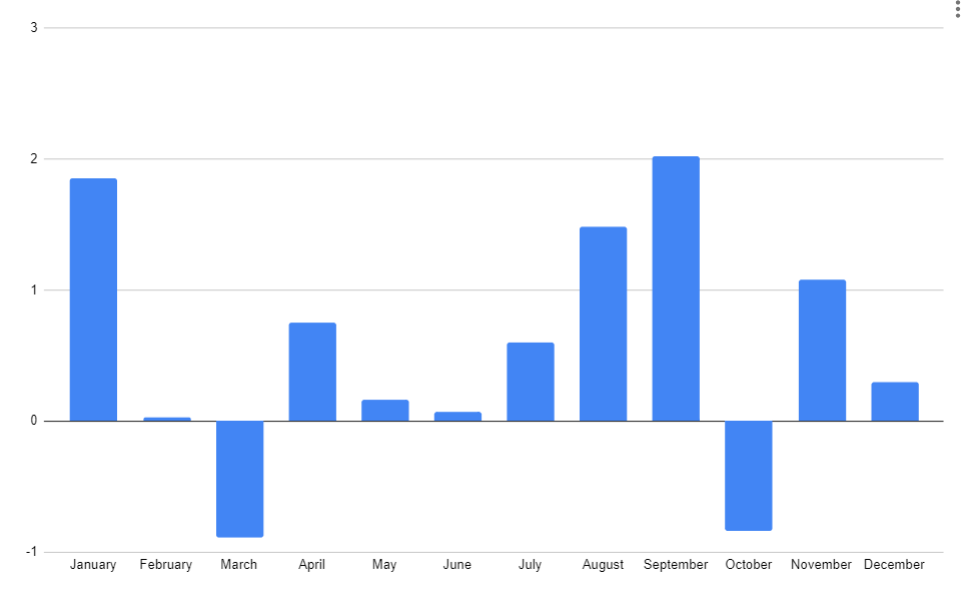 Gold price change by month based on statistics since 1975
Gold prices usually decline during spring and summer, then rise again from late August through December.
Historically, March is the best month to buy gold, with prices staying low until the second quarter. Data since 1975 shows that early in the year, March, and late April are the most profitable buying periods.
Silver follows a similar pattern but with higher volatility due to its smaller market and shifting industrial demand. January, March, and mid-June to July are typically good times to buy silver.
The best months to invest in gold are January, August, September, and December, when prices usually climb seasonally. June and July often see dips, creating opportunities to buy at lower prices.
Gold typically reaches its highest value in September, driven by post-summer demand and jewelry sales before global holidays. Still, experts advise focusing on long-term trends rather than single months, since market conditions can change over time. Investors who follow seasonal cycles should also understand how to buy gold in a cost-efficient and secure way, so they can take advantage of temporary price declines while staying focused on long term portfolio growth.
What are the best brokers to trade gold?
For trading gold, regulated brokers with a wide selection of trading instruments such as futures, gold mining stocks, ETFs, and CFDs are most suitable. Here's a comparative table of the top brokers for trading gold:
| ZForex | Plus500 | OANDA | FOREX.com | IG Markets | |
|---|---|---|---|---|---|
|
Gold Trading |
Yes | Yes | Yes | Yes | Yes |
|
Stocks |
Yes | Yes | Yes | Yes | Yes |
|
Futures |
No | Yes | No | Yes | Yes |
|
ETFs |
No | Yes | No | Yes | Yes |
|
Min. deposit, $ |
10 | 100 | No | 100 | 1 |
|
Regulation |
No | CySEC, FCA, ASIC, FMA, FSCA, FSA Seychelles, EFSA, MAS, DFSA, SCB | FSC (BVI), ASIC, IIROC, FCA, CFTC, NFA | CIMA, FCA, FSA (Japan), NFA, IIROC, ASIC, CFTC | FCA, BaFin, ASIC, MAS, CySec, FINMA, BMA, CFTC, NFA |
|
Open account |
Go to broker Your capital is at risk.
|
Go to broker 80% of retail CFD accounts lose money. |
Go to broker Your capital is at risk. |
Study review | Study review |
What will gold be worth in 10 years?
Predicting future gold prices is not precise due to the many unpredictable factors that can affect the market over extended periods. Still, past patterns can give a basic idea of potential gold price trends in the coming ten years. This rough goal suggests that current prices, adjusted for inflation, are still lower than peak records from the early 1980s. However, it's important to note that gold isn't guaranteed to follow past patterns, as unforeseen events or changes can always arise.
Looking ahead, it's smart for long-term investors not to focus too much on predicted price goals. Staying focused and disciplined as circumstances change is more beneficial than depending on ten-year forecasts.
In the end, reacting smartly to evolving big-picture situations over the investment period is most important for success - not sticking to random future price estimates.
Now, looking at updated forecasts, many major banks and financial institutions have issued 2026 gold price predictions (per ounce):
High Range ($4,500 – $5,000)
Bank of America: $5,000
Goldman Sachs: $4,900
HSBC: $5,000 (early 2026 forecast; 2025 average ~ $3,455)
Mid Range ($3,800 – $4,499)
Deutsche Bank: $4,000
Morgan Stanley: expects the rally to continue through 2026, possibly approaching $4,200
Société Générale: around $4,000
Lower Range ($3,200 – $3,799)
UBS: $3,700 by mid-2026
ING Bank: $3,500 average for 2026
Commerzbank: $3,300 – $3,600 depending on Fed policy trajectory
Overall, most banks expect gold to remain in a strong bullish phase throughout 2026, driven by prolonged monetary easing, persistent inflationary pressure, and robust demand from both central banks and institutional investors.
Traders Union uses a custom-made forecasting model with the following prediction:
| Year | Price in the middle of the year | Price at the end of the year |
|---|---|---|
| 2026 | $4300 | $5200 |
| 2027 | $5300 | $5200 |
| 2028 | $5100 | $5000 |
| 2029 | $5300 | $5100 |
| 2030 | $5200 | $5300 |
| 2031 | $5200 | $5300 |
| 2032 | $5400 | $5500 |
| 2033 | $5800 | $5900 |
| 2034 | $5700 | $5800 |
| 2035 | $5800 | $5800 |
| 2036 | $5900 | $6000 |
| 2037 | $6300 | $6600 |
| 2038 | $7300 | $8300 |
| 2039 | $8400 | $8300 |
| 2040 | $8300 | $8100 |
You can read this article - Gold (XAU) price prediction to get more insights of Gold’s forecasting.
Practical tips for buying gold at the right time
Things to consider when timing gold purchases:
Set price alerts to catch gold at seasonal lows.
Watch global and economic trends since rate hikes or conflicts often drive gold prices up.
Diversify purchase months instead of investing all at once; consider March, October, or February.
Use dollar-cost averaging to invest fixed amounts regularly and reduce risk.
Place limit orders to automate buys when gold hits your target price.
Explore gold ETFs or mining stocks for added diversification.
Keep some cash ready to seize opportunities quickly.
Track seasonal patterns and market news for smarter long-term accumulation.
I always advise investors to treat seasonal patterns as reference points

As an analyst observing gold’s long-term performance, I always advise investors to treat seasonal patterns as reference points, not rules. While data shows recurring cycles of lower prices in spring and stronger rallies toward the year’s end, true investment success lies in combining timing with broader macroeconomic awareness.
Before entering the market, I recommend monitoring monetary policy signals – especially interest rate expectations and inflation trends – since these factors have a far greater impact on gold’s trajectory than any single month’s average. Investors should also view gold as a hedge within a diversified portfolio rather than a speculative instrument. Allocating a steady portion of capital through dollar-cost averaging can often yield better outcomes than attempting to time short-term dips.
In essence, gold rewards discipline and patience. By aligning seasonal entry points with long-term fundamentals and maintaining realistic expectations, investors can use it effectively as both a store of value and a stabilizer against market uncertainty.
Conclusion
Ultimately, the most strategic takeaway from this analysis is that while timing your gold purchases during traditionally lower-priced months like March or October can offer value, lasting investment success depends on a disciplined, long-term approach combined with macroeconomic awareness. Attempting to pinpoint the absolute lowest price each year can be less effective than regularly accumulating gold, especially through methods like dollar-cost averaging that smooth out volatility. For example, investors who steadily build their positions during seasonal lows—and remain attentive to global monetary trends—are often better positioned to ride out market swings. Remember, gold rewards patience and foresight more than perfect timing. Treat seasonal patterns as helpful guides, but always prioritize fundamentals and portfolio diversification to maximize gold’s potential as a safe haven.
FAQs
What are the main factors that cause gold prices to fluctuate throughout the year?
How does gold compare to other investment options during periods of low interest rates?
Is it possible to use historical price data to reliably predict the lowest gold prices each year?
What role does gold play in a diversified investment portfolio?
Editors' Top Picks and Insights

Toncoin becomes Gram: Why Durov restored token's original name

Why Tether flipping Ethereum is a pivotal moment for crypto

MiCA deadline: Why crypto companies are leaving Europe

From “Holy Trinity” to WLD crash: How Arthur Hayes became a market-moving seller

The world's first trillionaire: How Musk built his fortune on electric cars, space and AI

How precious-metals mining revival is reshaping portfolios in 2026
Related Articles
Team that worked on the article
Upendra Goswami is a full-time digital content creator, marketer, and active investor. As a creator, he loves writing about online trading, blockchain, cryptocurrency, and stock trading.
Dr. BJ Johnson is a PhD in English Language and an editor with over 15 years of experience. He earned his degree in English Language in the U.S and the UK.
Mirjan Hipolito is a journalist and news editor at Traders Union. She is an expert crypto writer with five years of experience in the financial markets.
Volatility refers to the degree of variation or fluctuation in the price or value of a financial asset, such as stocks, bonds, or cryptocurrencies, over a period of time. Higher volatility indicates that an asset's price is experiencing more significant and rapid price swings, while lower volatility suggests relatively stable and gradual price movements.
CFD is a contract between an investor/trader and seller that demonstrates that the trader will need to pay the price difference between the current value of the asset and its value at the time of contract to the seller.
An investor is an individual, who invests money in an asset with the expectation that its value would appreciate in the future. The asset can be anything, including a bond, debenture, mutual fund, equity, gold, silver, exchange-traded funds (ETFs), and real-estate property.
Cryptocurrency is a type of digital or virtual currency that relies on cryptography for security. Unlike traditional currencies issued by governments (fiat currencies), cryptocurrencies operate on decentralized networks, typically based on blockchain technology.
Ethereum is a decentralized blockchain platform and cryptocurrency that was proposed by Vitalik Buterin in late 2013 and development began in early 2014. It was designed as a versatile platform for creating decentralized applications (DApps) and smart contracts.

-
 Afghanistan
-
 Albania
-
 Algeria
-
 Angola
-
 Argentina
-
 Armenia
-
 Australia
-
 Austria
-
 Azerbaijan
-
 Bahamas
-
 Bahrain
-
 Bangladesh
-
 Belarus
-
 Belgium
-
 Bolivia
-
 Botswana
-
 Brazil
-
 Brunei
-
 Bulgaria
-
 Cambodia
-
 Cameroon
-
 Canada
-
 Chile
Chile
-
 China
China
-
 Colombia
-
 Congo
Congo
-
 Costa Rica
-
 Cote d'Ivoire
-
 Croatia
-
 Cuba
Cuba
-
 Cyprus
-
 Czechia
-
 DR Congo
-
 Denmark
-
 Dominican Republic
-
 Ecuador
-
 Egypt
Egypt
-
 El Salvador
-
 Estonia
-
 Eswatini
-
 Ethiopia
-
 Finland
-
 France
-
 Georgia
-
 Germany
-
 Ghana
Ghana
-
 Greece
-
 Haiti
Haiti
-
 Hong Kong
-
 Hungary
-
 India
India
-
 Indonesia
-
 Iran, Islamic republic
-
 Iraq
Iraq
-
 Ireland
-
 Israel
-
 Italy
Italy
-
 Jamaica
-
 Japan
Japan
-
 Jordan
-
 Kazakhstan
-
 Kenya
Kenya
-
 Korea
Korea
-
 Kuwait
-
 Kyrgyzstan
-
 Laos
Laos
-
 Latvia
-
 Lebanon
-
 Lesotho
-
 Libya
Libya
-
 Lithuania
-
 Luxembourg
-
 Madagascar
-
 Malaysia
-
 Malta
Malta
-
 Mauritius
-
 Mexico
-
 Moldova
-
 Mongolia
-
 Montenegro
-
 Morocco
-
 Mozambique
-
 Myanmar
-
 Namibia
-
 Nepal
Nepal
-
 Netherlands
-
 New Zealand
-
 Nigeria
-
 North Macedonia
-
 Norway
-
 Oman
Oman
-
 Pakistan
-
 Palestine
-
 Panama
-
 Papua New Guinea
-
 Paraguay
-
 Peru
Peru
-
 Philippines
-
 Poland
-
 Portugal
-
 Puerto Rico
-
 Qatar
Qatar
-
 Reunion
-
 Romania
-
 Rwanda
-
 Saudi Arabia
-
 Serbia
-
 Singapore
-
 Slovakia
-
 Slovenia
-
 Somalia
-
 South Africa
-
 Spain
Spain
-
 Sri Lanka
-
 Sweden
-
 Switzerland
-
 Syria
Syria
-
 Taiwan
-
 Tajikistan
-
 Tanzania
-
 Thailand
-
 Trinidad and Tobago
-
 Tunisia
-
 Turkey
-
 UAE
UAE
-
 Uganda
-
 Ukraine
-
 United Kingdom
-
United States
-
 Uruguay
-
 Uzbekistan
-
 Venezuela
-
 Vietnam
-
 Yemen
Yemen
-
 Zambia
-
 Zimbabwe
- Forex
- Crypto